Delhi just put a date on its EV transition. Not 2032. Not 2035. April 1, 2028.
That's when no new ICE two-wheelers can be registered in the capital. Three-wheelers get there even sooner, from January 1, 2027.
I actually had to read those dates twice. Because whether you agree with the policy or not, those deadlines are a lot closer than I think most people expected.
And honestly? I like it*.
I have always believed industries move faster when someone eventually circles a date on the calendar. Deadlines force conversations that would otherwise drift for years. But while everyone was debating the ban itself, I found myself thinking about something else entirely.
Not the vehicles. Not the OEMs. Not even the batteries.
The infrastructure.
Because if there's one implementation pattern I have noticed over the years, it is this. Sometimes it feels like we are playing hopscotch with public policy. We throw the stone far ahead, decide where we want to land, and then spend the journey hoping the missing squares appear before we get there.
That thought took me straight back to Delhi's previous EV policy. When it was notified in 2020, the target was ambitious: around 45,000 public and semi-public charging points before the policy expired. By last year, only around 10% of that target had actually materialized. The new policy now targets 32,000 charging points. It's a smaller number. Probably a more realistic one. But it also means building a city-wide charging network in under two years, against the backdrop of a target that previously fell well short.
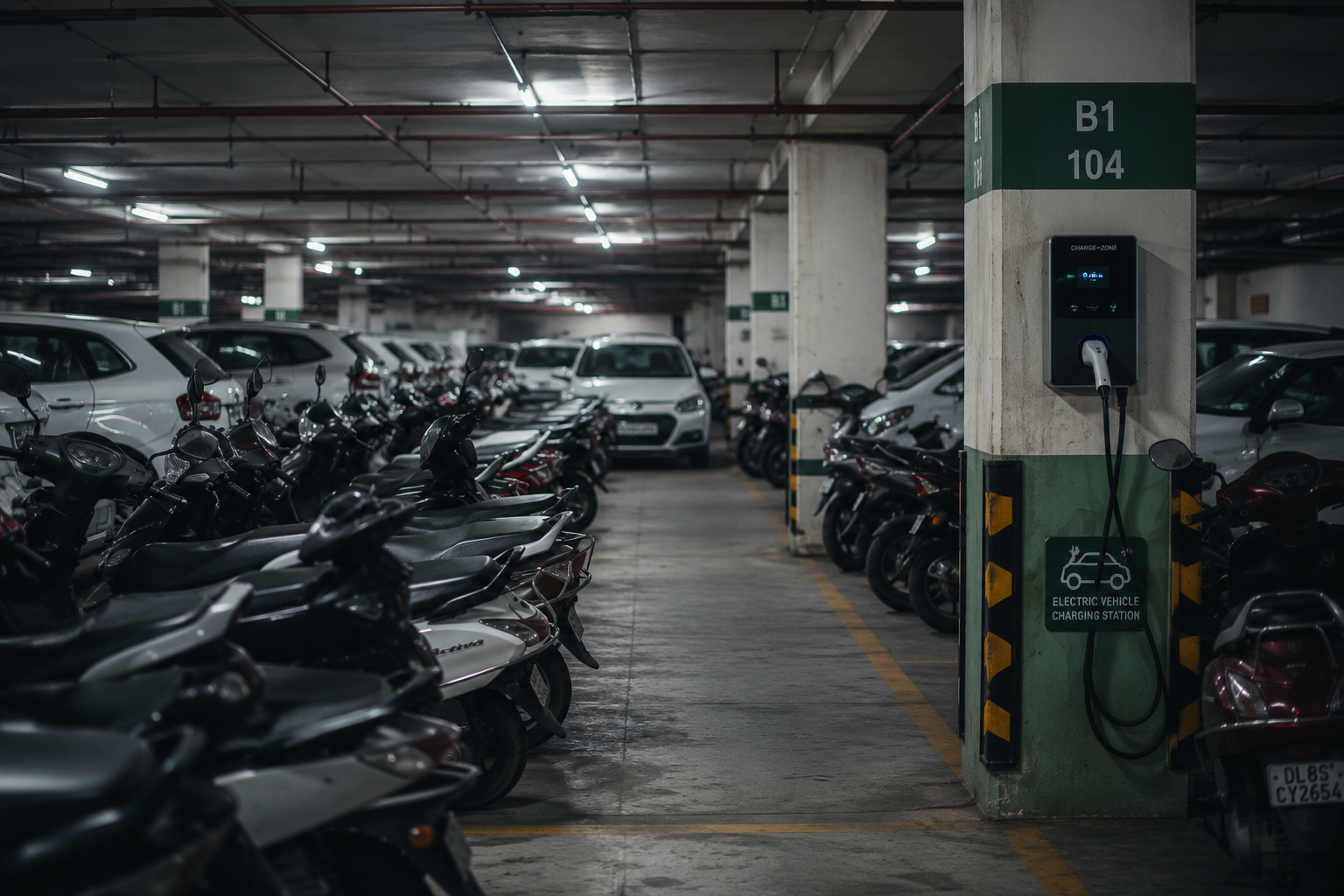
And that's before we even leave the policy document and enter the real world. Forget highways for a moment. Picture a residential apartment complex with 500 flats. Now imagine even half those residents own an EV by 2028. Where do 250 charging points go? Does the society even have enough sanctioned electrical load? Who pays to upgrade the electrical infrastructure? Who decides whose parking bay gets a charger first? At that point, this stops being an automotive problem. It becomes an urban planning problem.
Battery swapping usually enters the conversation around here. And to be fair, it solves a genuine problem. Time. But I'm not convinced it solves the other one. Density. If thousands of two-wheelers need energy before office hours every morning, the challenge does not disappear. It simply changes shape.
Swapping solves duration. It doesn't solve density.
And the more I thought about it, the more familiar the entire rollout felt. A fuel blend changes, and people spend the following weeks figuring out which engines, filters or components are actually affected. A payment system changes almost overnight, and queues appear while the supporting infrastructure catches up. A tolling system becomes digital, but for a while, the lanes seem ready before enough tags are. Different sectors. Different policies. The same implementation rhythm. Announce the destination. Build the runway while everyone is already trying to take off.
Now, before this sounds like I'm arguing against Delhi's EV Policy 2.0, let me be clear. I'm not. In fact, I think bold deadlines are exactly what transitions like this need. Without them, infrastructure has a habit of remaining permanently "under development." But deadlines and preparedness shouldn't have to race each other. I would much rather see charging infrastructure become so visible, so abundant and reliable that by the time April 2028 arrives, the registration ban almost feels inevitable. Not because people were forced into it. Because they were already ready for it.
And despite all the questions, there is one part of this policy that genuinely excites me. Delhi is about to become one of India's most fascinating EV battlegrounds. Ather, TVS iQube, Bajaj Chetak, Vida, River, Ultraviolette, Oben. Every one of them is about to fight for the same roads, the same customers and, perhaps most importantly, the right to define what electric mobility in the capital actually looks like. That battle will be fascinating to watch.
Which brings me back to where I started. I don't think the destination is the problem. I think the sequence is. Because policies are remembered for the dates they announce. People remember something else. Whether living through them actually felt ready. And that's the part I hope we eventually stop treating like a game of hopscotch.
*if the infrastructure is ready for it. Otherwise, April 1, 2028 makes us seem like the actual fools.